- Sunda
- Plan a Trip to Bandung
- Things to Do in Bandung
- Tahura Djuanda
Tahura Djuanda Bandung: Trails, Caves, and Waterfalls
Step under a cool rainforest canopy in Tahura Djuanda Bandung, and the city noise quickly gives way to forest trails, hidden caves, and distant waterfalls. Taman Hutan Raya Ir. H. Djoeanda isn’t just a park—it’s a network of paths that can carry you from scenic cliffs to Maribaya in a single, easy hike. Along the way, you’ll pass historical bunkers, suspension bridges, and shaded picnic spots that make the journey as rewarding as the destinations. With so much to explore, here’s a quick guide to where to enter, what to see, and how to plan your route to make the most of your visit.
 Gate 1 of the 5 gates in Tahura Djuanda (Juanda Forest Park), Bandung.
Bandung's largest urban forest reserve in Dago Pakar was named after the West Javanese national hero Ir. H. Rd. Djoeanda Kartawidjaja. As a result, the official name of the park is Taman Hutan Raya Ir. H. Djuanda, commonly shortened to Tahura Djuanda or THR Djuanda, and loosely translated into English as Juanda Forest Park.
There are five gates to enter Tahura Djuanda. Gates 1, 2, and 3 are clustered near a spacious parking lot in front of gate 1. Access to gates 1 and 2 is via Ir. H. Juanda Street (formerly known as Jalan Dago). Gate 5 is located farther north near Tebing Keraton, while gate 4 is in Maribaya, Lembang. Choosing a gate depends on what you want to do in Tahura Juanda.
When you purchase your ticket at the entrance, you'll receive two items: a paper ticket with a map of Tahura Djuanda on the back and a rubber wristband. Simply wear the wristband during your visit, so you don't have to worry about losing your ticket.
 Take a look at the back of your ticket and you’ll find a handy map of Tahura Juanda, complete with distances between places.
The easiest trail is to walk from gate 1 or 2 to the Dutch Cave. It’s about a 1-kilometer walk, and you only need to follow the asphalt road. Alternatively, you can visit the Japanese Cave first. The Dutch Cave is one of the most popular attractions in Juanda Forest Park. It served as a bunker during the war. You may explore the cave or walk through it and continue hiking to Maribaya.
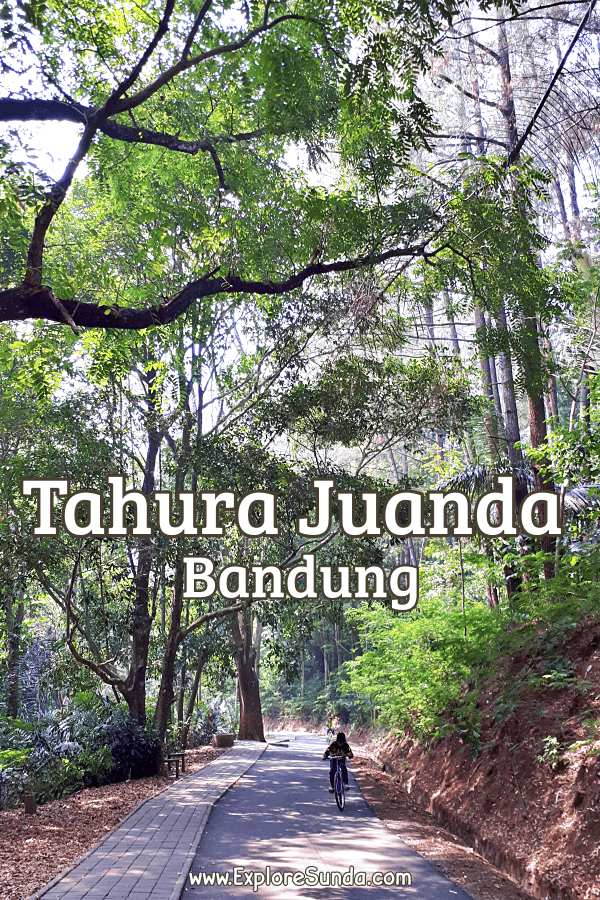
 The smooth asphalt road to Goa Belanda (Dutch Cave) is a favorite for leisurely bike rides.
If you plan to do the longer walk, I recommend walking from gate 1 or 2 in Dago, Bandung, to gate 4 in Maribaya, Lembang, or vice versa. This walk is fun for the whole family because it is a light hike, provided you are prepared to walk approximately 7 km. Along the way, you will walk beneath the rainforest canopy, pass through the Dutch bunker, and walk over the hanging bridge near Curug (waterfall) Koleang.
One of Tahura Djuanda's most fascinating attractions is the Dutch and Japanese cave complex. These wartime tunnels can be explored on foot and offer a glimpse into Bandung's colonial and WWII history. Read the full cave guide here...
 Once a bunker and ammunition warehouse, Goa Belanda (Dutch Cave) in Tahura Djuanda is now open for visitors to explore.
Don’t forget to bring a bottle of water, wear comfortable clothes and shoes, wear a hat, and use sunscreen or mosquito repellent, as you will be outdoors for several hours. Don’t worry if you run out of water. Several kiosks are scattered throughout the park, selling bottled water, soft drinks, and snacks such as chips and instant noodles.
Cikapundung River flows through Tahura Djuanda, creating several waterfalls within the park. Besides Curug Omas in Maribaya and Curug Koleang, the park is also home to Curug Kidang, Curug Lalay, and Curug Dago.
Curug Dago is still part of THR Juanda, although it is located farther south and separated from the main park by streets and residential areas. It is a small waterfall, standing 12 meters high. It is famous for inscriptions left by the Kings of Thailand, Rama V and Rama VII, during their visits to Java. Unfortunately, urban pollution has affected the water quality of the Cikapundung River around Dago Waterfall. As a result, the water is often brownish.
Juanda Forest Park is also home to monkeys, various bird species, and deer. The deer breeding area is approximately 4 kilometers from gate 1. You can buy carrots and feed the deer. On the other hand, although the monkeys may look cute, you should not feed them because once they become accustomed to being fed by humans, they may snatch anything you are holding when they are hungry.
If you are lucky—when the water level of the Cikapundung River is low—you may be able to see Batu Batik. It was formed from thousands-of-years-old lava from an eruption of Mount Tangkuban Perahu that cooled and solidified into stone. The solidified lava created patterns on the stone. Some people say the pattern resembles batik, while others call it Dayang Sumbi's shawl (Dayang Sumbi is a figure from the legend of Tangkuban Perahu).
History of Tahura Djuanda
In 1912, the Dutch colonial government designated an area on Mount Pulosari as the Pulosari Protected Forest. The protected forest originally covered 590 hectares, stretching from Curug Dago in Dago, Bandung, to Maribaya in Lembang. By 2003, the forest had shrunk to 526 hectares.
 This breathtaking forest scenery is just minutes from downtown Bandung.
Today, the area is managed as a forest park and is named after West Javanese national hero Ir. H. Rd. Djoeanda Kartawidjaja. Its official name is Taman Hutan Raya Ir. H. Djuanda, commonly shortened to Tahura Djuanda. However, many locals are still more familiar with Dago Pakar, the name of the surrounding area, than the park's official name.
More Fun Activities in Juanda Forest Park
 Directional signs point the way to Tahura Djuanda's many attractions.
Easy hiking may be the main draw at Tahura Djuanda, but there is much more to explore.
If you enter THR Djuanda through gate 1 or 2, you will come across Tahura Plaza, the Ir. H. Juanda Museum, and a playground first. The plaza is an open space featuring a bust of Mr. Djoeanda and the famous Juanda Declaration displayed below it. Visitors often use the surrounding area for picnics. Next to the plaza is the museum, which provides information about the park and Mr. Djoeanda's contributions to Indonesia. Next to the playground is a more challenging obstacle course. Do keep in mind that children should be supervised at all times while using these facilities.
If you enter through gate 3, the nearest attraction is Tebing Keraton (Keraton means palace, while Tebing is the Indonesian word for cliff). The road leading to gate 3 is narrower than those leading to gates 1 and 2, but it provides quick access to Tebing Keraton, where you can enjoy views of Tahura Juanda's pine forest and the Lembang Fault. Tebing Keraton is also a popular spot for watching the sunrise.
How to Go to Tahura Djuanda (Juanda Forest Park)

Address:
Kompleks Taman Hutan Raya Ir. H. Djuanda No. 99 Dago Pakar, Bandung
Ticket:
Local: Rp. 17,000
Foreigner: Rp. 57,000
Car: Rp. 12,000
Opening Hours:
07.30 - 17.00 daily
Tahura Juanda is located at Kompleks Taman Hutan Raya Ir. H. Djuanda No. 99, Dago Pakar, Bandung. Its coordinates are -6.85884, 107.63073. It is approximately 2 kilometres from Terminal Dago (Dago Bus Station), the final stop for most public transport routes serving Dago. From the terminal, you can either walk approximately 2 kilometres or take an ojek (motorcycle taxi).
The most convenient way to reach gates 1 and 2 is by using ride-hailing services such as GoJek and Grab, or by taking a BlueBird taxi. However, if you want to go directly to gate 3, the entrance closest to Tebing Keraton, you will need to take an ojek. The route is about 5 kilometers uphill. Most of the road is accessible by car, but the final section is too narrow for vehicles. GoJek and Grab both have options for cars and motorcycles.
You might like these too ...
Bandung Factory Outlet | Great Shopping Experience For Everyone
Visiting Bandung will never be the same without shopping in the famous Bandung Factory Outlet! Get to know the best shops here...
Ciwidey, Bandung: A Family Vacation to Kawah Putih and Situ Patenggang
Full pack information on things to do in Ciwidey, Bandung: explore Kawah Putih, Situ Patenggang, Ranca Upas, Rancabali tea plantation, and where to go glamping!
Pasar Baru Bandung: No. 1 Textile Centre In The Heart Of Bandung
Add flavor to your Bandung shopping experience by visiting Pasar Baru Bandung. Let's have a shopping spree!
Bandung | Top 12 Things to Do
The list of top 12 activities people love to do in Bandung: shopping, culinary adventure, visit museums, horse riding, play in the parks and more. What's yours?
Bandung Shopping Guide: The List of Top 11 Shopping Malls in Bandung
Here is the list of the best Bandung shopping malls! Find out things to do, cuisines to dine, and items to buy in each mall.
Bandung Shopping Guide | Top 3 Souvenir Shops in Bandung
Bandung shopping guide provides you with an important list of what are the unique Sundanese souvenirs and where to get them!
Bandung Shopping Guide: Hunting Delicious Snacks in Bandung
Bandung shopping guide will help you find delicious snacks in Bandung: what are they and where are the snack shops!


Recent Articles


-
Where Is Bandung? Location, Time & Weather
Aug 17, 26 01:26 AM
 Planning to go to Bandung? Find out where is Bandung, what time it is, how the weather changes, and what to wear from day to night before you go.
 -
About ExploreSunda | Sunda Travel Guide
Aug 12, 26 10:37 PM
 Discover Sunda in western Java with clear, practical travel guides. Learn why ExploreSunda was created to help independent travelers navigate the region.
 -
Trip to Bandung Indonesia: Plan It Your Way
Aug 11, 26 05:53 AM
Planning a trip to Bandung Indonesia? Find practical advice on transport, getting around, where to stay, things to do, and local food to help you plan your trip.


%20by%20exploring%20its%20scenic%20forest%20trails.%20Along%20the%20way%2C%20you'll%20find%20historic%20Dutch%20and%20Japanese%20caves%2C%20beautiful%20waterfalls%2C%20the%20breathtaking%20cliffs%20of%20Tebing%20Keraton%2C%20and%20the%20trail%20that%20continues%20to%20Maribaya.)