Sangkuriang – The Legend of Mount Tangkuban Perahu
Long ago, when legends still breathed through the mountains, the tales of Sangkuriang and Mount Tangkuban Perahu are entwined, echoing through time as one.
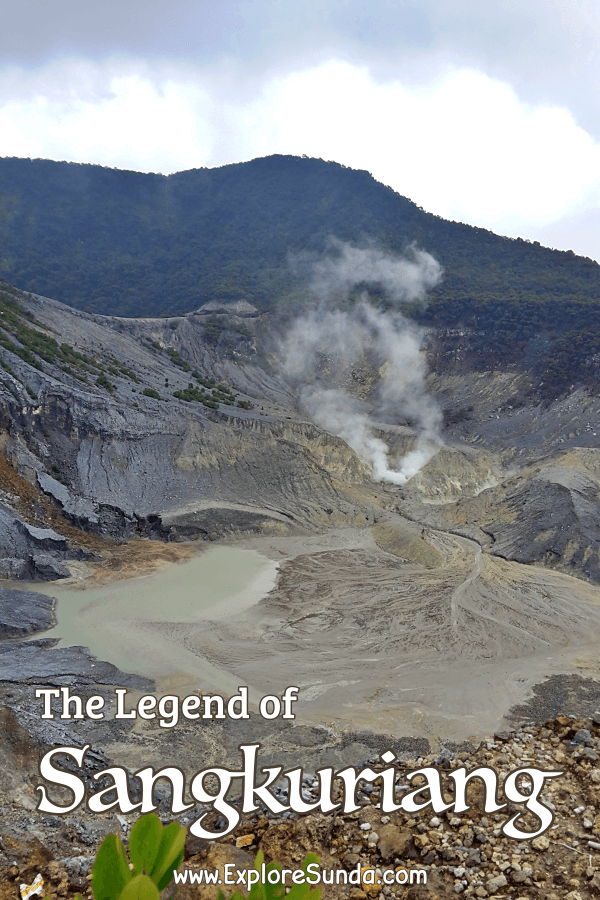
The name of Tangkuban Perahu originates from the Sundanese name of the mountain: Tangkuban (overturned) and Parahu (boat), which is based on the the legend of Sang Kuriang and the shape of the mountain.
For centuries, the tale of Sang Kuriang has been passed down verbally from generation to generation. Its existence is seeped into a script by Bujangga Manik, a prince of the Sunda Kingdom, who did extensive travel throughout Java and Bali in the 15th century.
Bujangga Manik wrote in old Sundanese language:
Leumpang aing ka baratkeun, datang ka bukit Patenggeng,
Sakakala Sang Kuriang, masa dek nyitu Ci Tarum, burung tembey kasiangan …
The free translation is:
I walked to the west, arrived at Patenggeng hill, the legend of Sang Kuriang,
how he failed to dam Citarum river in one night (when the new day came) …
This story happened in the time when people still believed in gods and goddesses who resided in svargaloka (heaven). When they did wrongdoing, they were punished to become animals on earth. Please remember that as far as the legend goes, anything could happen, especially magical things.
The story of Sangkuriang begins with …
One day a god was punished to become a dog named Tumang and a goddess to become a boar named Celeng Waluyang (Celeng is a Sundanese word for a boar). Both were sent to live in the forest.
When the king hunted in the forest, he found a baby, the daughter of the boar. He named her Dayang Sumbi and raised her up to become a beautiful maiden.
Dayang Sumbi’s pastime was to weave many beautiful fabrics. One day one of her weaving tools fell down. Since nobody was around, nobody helped her. Being desperate, she announced whoever gave her weaving tool back she would consider her a sister if she's a girl or marry him if he's a man.
To her surprise it was Tumang, a god punished to live as a dog, who brought back her weaving tool. Bound by the oath she had made, Dayang Sumbi married him, and not long after, their son Sangkuriang was born.
One day she asked her son to hunt, so he went to the forest with Tumang. Sadly, Sangkuriang couldn't find any prey that day. In a thoughtless act, he killed Tumang, cooked it and served it to his mother. When Dayang Sumbi discovered the truth, she was so furious that she hit his son’s head with a rice spoon and banished him.
Many years later, Sangkuriang returned to his village and met a beautiful lady. He didn't know that the lady was his mother, since the legend said the god granted Dayang Sumbi an eternal youth. In no time he fell in love with her and proposed to marry her.
One day, by chance, Dayang Sumbi noticed a scar on Sangkuriang’s head—the very mark she had left long ago. In that moment, the truth struck her: the man before her was her long-lost son.
To stop the marriage, Dayang Sumbi set an impossible task. She asked Sangkuriang to dam the Citarum River and build a great boat—all before dawn. Eager to prove himself, Sangkuriang summoned spirits to aid him. As the night deepened, the work neared its end, and fear filled Dayang Sumbi’s heart.
Desperate, she ran toward the horizon and waved her red shawl. Its fluttering caught the night light, glowing like the break of dawn. The roosters crowed, and farmers stirred from their sleep, believing morning had come.
Thinking he had failed, Sangkuriang’s anger erupted. He kicked the unfinished boat with all his might, and it toppled over, becoming Mount Tangkuban Parahu. The waters that had gathered formed what we now know as the Bandung basin.
The dam Sangkuriang built on the Citarum River formed an enormous lake—the very place where Bandung now lies. Because of this, many believe the legend of Sangkuriang is closely tied to the origin of the city itself.
When Sangkuriang realized Dayang Sumbi had tricked him, rage consumed him. He stormed through the wedding preparations, scattering everything in his path. He kicked and overturned it all, and legend says those objects became the landscape of Citatah Karst in western Bandung. The hills are said to be remnants of the feast: Pasir Pawon — the kitchen, Pasir Leuit — the silo, Pasir Pabeasan — the rice container, Pasir Kancahnangkub — the upside-down pan, and Mount Hawu — the stove. Others, like Pasir Bende and Ketuk Cave, are linked to the sounds of musical instruments, while Pasir Manik reflects the sparkle of jewelry.
Sangkuriang chased Dayang Sumbi across rivers, each one bearing traces of their flight. At Ci Bukur, it’s said leftover food remained, and at Ci Luncat, they leapt from stone to stone to cross the rushing waters. Weary from the pursuit, Sangkuriang finally paused to rest and sunbathe at Rancamoyan — “ranca” meaning swamp, and “moyan” meaning to bask in the sun.
The beauty of this tale lies in how it’s etched into the very landscape. From Mount Tangkuban Perahu in the north, across the ancient lake basin that became the Bandung valley, to the weathered limestone hills of Citatah in the west, the earth itself seems to carry the memory of this legend. For centuries, these stones have been silent witnesses to the story — though much of the karst has been mined away, the whispers of the past still remain.
It is as if the land itself became the storyteller. Geologically, the flat peak of Mount Tangkuban Perahu was formed by a series of powerful eruptions that left behind twelve craters. Among them, the most famous is the Queen crater at the top of the mountain, while visitors can boil eggs in the steaming earth of the Domas crater. On the mountain’s slope lies the enchanting Orchid Forest Cikole adding another layer of wonder to this legendary landscape.
The legend of Sangkuriang does not live in words alone — it lives in the mountains, the valleys, and the rivers of Bandung, etched forever into the land.



You might like these too ...
Prambanan Temple: The History, The Legend, The Ballet, The Present-Day
Prambanan Temple – the most famous Hindu temple in Indonesia, will take you back through time to see the history, the relief of Ramayana, and the classical Javanese art in Roro Jonggrang and Ramayana ballet.
Situ Patenggang Bandung: Serene Lake, Legend & Travel Guide
Explore Situ Patenggang Bandung, a scenic volcanic lake in Ciwidey. Discover its legend, things to do, travel tips, and the easiest way to get there.
Famous Sundanese Folklores | The Legend | The Drama | The History
Explore the rich culture of Sunda through its folklore. Read the popular Sundanese folklores such as Sangkuriang, Ciung Wanara, and Lutung Kasarung, here...
Lutung Kasarung | The Famous Sundanese Folklore
A God sent to earth to find his true love, a princess exiled to the woods... But what a langur has to do in the legend of Lutung Kasarung?
Situ Bagendit | The Famous Legend from Garut
Situ Bagendit is a beautiful and tranquil lake near Garut. Who knows it has a tragic legend of a rich, stingy widow named Nyi Bagendit?
Ciung Wanara | The Famous Legend of King Manarah from Galuh Kingdom
Exiled since a baby, Ciung Wanara returned to Galuh Kingdom to avenge his parents and take his right as King Manarah of Galuh Kawali. Here's how the story goes.
Karang Nini and Bale Kambang | The Famous Legend from Pangandaran
Read the love story of Aki Angga Piara and Ambu Kolot, which ended with the appearance of Karang Nini and Bale Kambang near Pangandaran beach.




Recent Articles


-
Kawasan Wisata Punclut Bandung: Cafes & Views in Sarae Hills
Sep 28, 26 09:07 AM
 Discover Punclut Bandung at Sarae Hills—cool breezes, sunset views, and cliffside cafes with photo spots, playgrounds, and diverse dining options.
 -
Restaurants in Bandung: Where to Eat & What to Try
Sep 28, 26 08:53 AM
 Planning where to eat? This guide to restaurants in Bandung shares local favorites, Sundanese food, historic spots, steaks, snacks, and more.
 -
Glamping Lakeside Bandung | Explore Situ Patenggang in Style
Sep 23, 26 10:24 AM
Planning a trip to Glamping Lakeside Bandung? Here's what to expect, how to get there, nearby attractions, and how to pair it with Kawah Putih.